
Key Takeaways:
- Expect to spend $25–$65/sq ft in 2026, putting most standard basement remodels between $12,500 and $37,500 — though mid-range projects with a bathroom and upgraded finishes typically land closer to $30,000–$75,000 for a 1,000 sq ft space.
- Bathrooms are the single biggest cost driver, adding $6,000–$25,000+ to your project depending on scope — and they’re also the addition most likely to improve your ROI at resale.
- Where you live can double your costs. A mid-range 1,000 sq ft remodel that runs $40,000–$60,000 in the Midwest can easily hit $85,000–$110,000 in the DC suburbs or exceed $100,000 in Seattle, due to stricter codes and higher labor rates.
- Always budget a 10–15% contingency — waterproofing issues, mold, foundation cracks, and HVAC extensions are common surprises that can add thousands mid-project before a single piece of drywall goes up.
- The average ROI is 71%, meaning a $50,000 project typically adds around $35,000 in resale value — not dollar-for-dollar, but among the better-performing interior renovation categories, especially if you add a legal bedroom and bathroom.
If you’ve been staring at that unfinished basement and wondering whether now’s finally the year to do something about it — you’re not alone. Basement remodels have surged in popularity as homeowners look for ways to squeeze more livable square footage out of their existing footprint rather than buying up or building an addition. But here’s the thing: the cost data online is all over the place, and a lot of it is outdated.
So let’s cut through the noise. This guide breaks down what a basement remodel actually costs in 2026, what’s driving prices up, where you can save, and whether the investment actually pays off when it’s time to sell.
The National Average: What Are Homeowners Actually Spending?
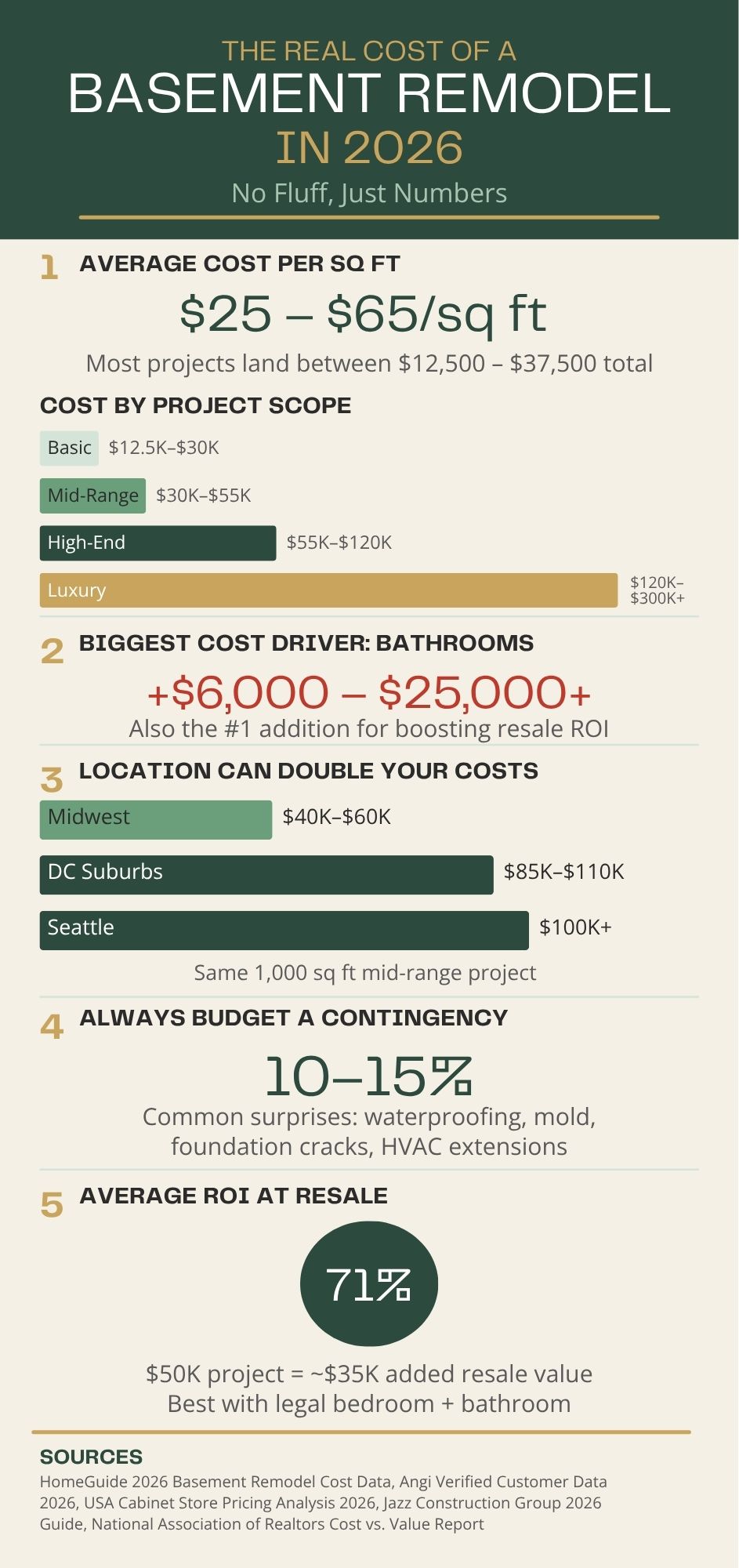
Let’s start with the headline number. According to HomeGuide’s 2026 data, the average basement remodel runs between $25 and $65 per square foot, putting most total projects in the $12,500 to $37,500 range with labor included. Angi’s verified customer data narrows that to a typical range of $12,024 to $34,632, with a midpoint average of roughly $22,883.
But here’s the important context: these numbers represent fairly standard finishing work. If you’re adding a bathroom, home theater, or full kitchen, costs climb considerably faster.
Construction pricing in 2026 hasn’t gotten any friendlier. According to a pricing analysis from USA Cabinet Store, overall construction costs for basement work have risen 5.6% year-over-year, driven by persistent material inflation and labor shortages. The national average remodel that cost around $22,800 in 2025 now sits closer to $24,050 in 2026.
Quick reference: 2026 cost ranges by scope
| Project Scope | Cost Range |
| Basic finish (drywall, paint, flooring, lighting) | $12,500 – $30,000 |
| Mid-range (+ bathroom, upgraded flooring) | $30,000 – $55,000 |
| High-end (+ home theater, custom finishes, smart home) | $55,000 – $120,000+ |
| Luxury full conversion | $120,000 – $300,000+ |
Cost Per Square Foot Breakdown
Square footage is the most reliable starting point for estimating your budget — and 2026 per-square-foot rates reflect the ongoing inflationary pressure across the construction industry.
Jazz Construction Group’s 2026 guide breaks it down cleanly by finish tier:
- Basic renovation (open plan, carpet, standard lighting): $30–$50/sq ft
- Mid-range renovation (bathroom, laminate flooring, wet bar): $50–$80/sq ft
- High-end renovation (structural changes, home theater, luxury bath): $80–$120+/sq ft
So what does that look like by size?
Cost by basement size (mid-range finishes):
| Basement Size | Estimated Cost |
| 400 sq ft | $10,000 – $17,500 |
| 600 sq ft | $18,000 – $30,000 |
| 1,000 sq ft | $30,000 – $75,000 |
| 1,500 sq ft | $45,000 – $110,000 |
| 2,000 sq ft | $58,000 – $120,000+ |
One thing worth noting: square footage isn’t the only variable. The complexity of your layout, ceiling height, existing structural conditions, and what’s already plumbed or wired below grade will all shift these numbers. Northside Remodeling points out that Googling average costs can be genuinely misleading because site-specific factors — moisture levels, soil type, municipal code requirements — create enormous local variation that national averages simply can’t capture.
What’s Included in a Basement Remodel? (And What Each Component Costs)
A basement remodel isn’t a single line item — it’s a collection of trades, each with their own pricing. Here’s how the major components break down in 2026:
Framing and Drywall
Framing the walls is typically the first structural step after any waterproofing work. Drywall installation runs $1.50 to $3 per square foot, according to Angi. Not the most expensive piece, but it adds up quickly in a 1,000-square-foot space.
Flooring
Moisture is the enemy of most flooring materials, so basement floors require careful material selection. HomeGuide reports that flooring typically costs $4–$15 per square foot for standard options like vinyl plank or carpet. Tile — the premium, most moisture-resistant option — runs $6–$20 per square foot. Luxury vinyl plank (LVP) has become the overwhelming favorite for basements in 2026: it’s 100% waterproof, looks like hardwood, and lands in the affordable-to-mid range.
Electrical and Lighting
HomeGuide’s data puts electrical wiring at $4–$9 per square foot with labor, or roughly $2,000–$9,000 for a 500–1,000-square-foot space. Recessed lighting — the standard choice for low-ceiling basements — runs $125–$300 per light, with a typical six-can setup totaling $700–$1,650.
Insulation
Basements are partially insulated by the surrounding earth, so you may not need as much as the rest of your home. Angi notes that insulation averages $1.50–$2.50 per square foot, while HomeGuide’s data puts the total range at $500–$4,500 for a typical basement. Don’t skip it — proper insulation is critical for comfort and moisture control.
Plumbing
Any time you add plumbing — even just roughing in pipes — expect costs to jump. HomeGuide puts plumbing rough-in at $450–$1,800 per fixture or $4–$6 per square foot for piping alone. Adding a full bathroom balloons that number significantly, which we’ll cover in the next section.
Permits
A frequently overlooked line item. Angi’s data puts basement remodel permits at $500–$2,000 depending on your municipality. Skipping permits is a mistake — it can create major headaches at resale and may violate your homeowner’s insurance policy.
The Big Add-Ons: What Specific Features Will Cost You
Beyond the base finish, the features you choose to incorporate will have the single biggest impact on your final budget. Here’s what the major ones cost in 2026:
Bathroom Addition: $6,000–$25,000+
A bathroom is the most requested basement addition — Angi found that roughly 26% of homeowners planning a basement remodel want to add one. Pricing varies significantly based on scope:
- Half bath: $6,000–$12,000
- Full bath with shower: $12,000–$25,000
Allure Plastic Surgery’s cost guide — which, despite the unusual name, compiles contractor pricing data — notes that drainage depth, vent routing, and waterproofing requirements are the biggest variables. If your basement lacks existing rough-in plumbing, expect to land firmly at the higher end.
Higher-end contractors like Advance Design Studio note that a bathroom in a luxury basement remodel can start at $25,000+ on top of the base project cost once you factor in premium fixtures, custom tile, and heated floors.
Home Theater: $10,000–$42,000
The dream for many homeowners. HomeGuide puts a basic home theater at $2,000–$42,000 total, with the lower end covering a projector screen and basic audio. A proper setup with soundproofing, tiered seating, quality AV equipment, and acoustic paneling typically runs $10,000–$20,000 for mid-range execution.
Theaters push per-square-foot rates to the $80–$120+ range for that section of the basement, so plan accordingly.
Wet Bar or Kitchenette: $2,000–$30,000
A wet bar is a popular mid-range upgrade that dramatically improves a basement’s entertainment value. HomeGuide reports prefabricated wet bars at $2,000–$12,000, while custom bars run $10,000–$30,000. Advance Design Studio notes that a full kitchenette typically starts around $20,000 once plumbing, cabinetry, and appliances are factored in.
Bedroom Conversion: $15,000–$35,000
Turning basement space into a legal bedroom requires meeting specific building code requirements — particularly around ceiling height and egress. USA Cabinet Store’s 2026 guide puts bedroom additions at $15,000–$35,000 per bedroom, noting that the 2026 International Residential Code (IRC) requires a minimum 7’6″ ceiling height, a proper egress window, a closet, and a hardwired smoke detector.
Angi found that about 19% of homeowners wish to add a bedroom to their basement — and it’s worth noting that adding a legal bedroom and bathroom is one of the highest-ROI moves you can make in a basement conversion.
Home Office: $800–$3,000
Relatively affordable compared to the other options. A functional home office conversion — covering lighting, furniture, and minor electrical or HVAC modifications — typically runs $800–$3,000, making it one of the more budget-friendly basement use cases.
Regional Price Differences: Where You Live Matters Enormously
National averages only tell part of the story. Labor costs, permit complexity, and local demand can push prices well above — or below — the national figures.
High-cost metro areas see the most dramatic premiums:
- Washington DC Metro Area: Basement Remodeling’s cost calculator puts finishing costs at $49–$300 per square foot in the DC area, compared to the national average. A premium 1,000-square-foot finish runs $85,000–$110,000 in Maryland and Virginia suburbs — 40–60% above national benchmarks due to stricter building codes and higher labor costs.
- Seattle / Pacific Northwest: Emerald City Construction reports that most basement remodels in Seattle and the Eastside run $105,000–$400,000+ for a standard 1,000-square-foot space. The combination of seismic reinforcement requirements, moisture control needs, and high local labor rates makes Pacific Northwest basement work some of the most expensive in the country.
Mid-market regions (Midwest, parts of the Southeast) tend to track closest to national averages, where a solid mid-range 1,000-square-foot remodel can still be done for $40,000–$60,000.
The takeaway: if you’re in a high-cost metro, assume national average estimates are a floor, not a ceiling.
Hidden Costs Homeowners Often Miss
The estimates above assume a relatively straightforward project. Real basements aren’t always cooperative. Here are the surprise costs that most frequently blow up budgets:
Waterproofing and Moisture Remediation
If your basement has any history of water intrusion — even minor dampness — you’ll need to address it before finishing. Interior waterproofing systems run $3,000–$10,000; exterior excavation and waterproofing can hit $15,000–$30,000+.
Mold Remediation
Discovered during demo, this can add $500–$6,000+ depending on severity and extent.
Foundation Repair
Cracks, bowing walls, or settling can require structural intervention costing $4,000–$15,000 before any finishing work begins.
HVAC Extension
Getting climate control into the basement requires either extending existing ductwork or installing a separate mini-split system. Mini-splits run $3,000–$8,000 installed; ductwork extension varies widely by complexity.
Egress Windows
Required for any legal bedroom conversion. Installing an egress window typically costs $2,500–$5,000 per window, including the well excavation.
The standard advice among contractors is to build in a 10–15% contingency fund on top of your baseline budget. Allure’s guide specifically recommends this buffer for structural surprises and inspection changes that come up mid-project.
2026 Trends Reshaping Basement Remodels

A few emerging factors are influencing both the cost and design direction of basement projects in 2026:
Smart Home Integration
USA Cabinet Store’s analysis notes that smart home integration is now standard in 78% of basement projects. Expect to budget $400–$1,200 for mesh Wi-Fi networks, $800–$1,500 for water detection systems, and $1,200–$3,500 for smart humidity control. Basements with smart infrastructure reportedly command 8–12% higher resale values than comparable non-smart finishes.
ADU and Rental Conversion
In high-cost housing markets, homeowners are increasingly building basement ADUs (accessory dwelling units) — essentially self-contained apartments with separate entrances. These require significant additional investment in separate utilities, kitchen facilities, and legal egress, but the rental income potential changes the ROI calculus entirely.
Sustainable Materials
Moisture-resistant, low-VOC, and recycled-content materials are gaining traction. They add modest cost premiums but improve indoor air quality — particularly relevant in basement environments where ventilation can be limited.
ROI: Does a Basement Remodel Pay Off?
Here’s the honest answer: it depends — but the data is generally encouraging.
According to the 2025 Cost vs. Value Report from Zonda and the Journal of Light Construction, the national average recovery rate for a basement remodel is approximately 71%. In practical terms: a $50,000 finished-basement project typically adds around $30,000–$40,000 in resale value — not a dollar-for-dollar return, but meaningful equity nonetheless.
Notably, the Cost vs. Value Report added basement remodels as a tracked category for the first time in 2025, reflecting the growing significance of the project type. At 71% ROI, it competes favorably against major kitchen remodels (around 65–70%) and mid-range bathroom remodels (80%), though it trails exterior upgrades like garage door replacement (268%) on pure return metrics.
But here’s where it gets nuanced: Opendoor’s detailed analysis notes that the spread is wide — some markets recoup as little as 23%, while others approach 80–86%. Walk-out basements, projects that add a legal bedroom and bathroom, and remodels in markets where finished basements are the norm (Midwest, Northeast) tend to recover the most.
A few factors that improve ROI:
- Adding a legal bedroom and full bathroom (highest-value combination)
- Walk-out or daylight basement access
- High-demand markets where additional square footage is at a premium
- Staying within the neighborhood value ceiling — over-improving relative to comparable homes limits return
One important appraisal note: standard appraisal guidelines report below-grade square footage separately from above-grade living area. Your finished basement adds value as an adjustment, not as additional gross living area (GLA) — which is why the math doesn’t return 100%.
How to Get the Most for Your Money
Whether you’re working with a $20,000 budget or a $100,000 one, there are smart ways to stretch it:
Keep the Layout Open
Fewer interior walls means less framing, less drywall, and less labor. An open-plan basement costs significantly less than a compartmentalized one with multiple defined rooms.
Choose LVP Flooring
Luxury vinyl plank is the cost-performance champion for basements in 2026. It’s fully waterproof, installs quickly, looks like hardwood, and costs a fraction of tile or real wood.
Go Industrial on the Ceiling
Instead of drywalling the ceiling — which requires careful coordination around ducts and wires — consider painting exposed joists and mechanicals black or dark gray for a modern industrial look. It’s a legitimate design choice that saves thousands in labor.
Do Your Own Demolition
If you’re clearing out an old unfinished space, demo is relatively unskilled work you can do yourself. Hauling debris and prepping the space before contractors arrive can save real money.
Get Multiple Bids
The contractor market has tightened, and pricing variance between bids can be surprising. Three competitive bids is the minimum for a project of this size.
Phase the Work If Needed
You don’t have to do everything at once. Rough in the plumbing now, finish the bathroom in year two. A good framing and electrical rough-in done properly today makes future additions far cheaper.
Final Thoughts
A basement remodel in 2026 is a meaningful investment — and a meaningful commitment. The national average sits around $22,000–$37,500 for standard finishing work, with mid-range projects running $30,000–$75,000 and high-end conversions climbing well past $100,000 in many markets.
The biggest cost drivers are plumbing additions (bathrooms, wet bars), smart home integration, structural requirements (egress windows, ceiling height adjustments), and the simple reality that labor and materials cost more than they did two years ago.
Done well — with permits pulled, moisture properly controlled, and features that match your market — a finished basement returns roughly 70% of its cost at resale while dramatically improving your home’s livability for however long you stay. For most homeowners, that combination is more than enough to make the math work.
The key is going in with realistic numbers, a solid contingency fund, and contractors who will show you a detailed, itemized bid. The basement that’s been sitting empty isn’t going to finish itself — but with the right planning, 2026 might finally be its year.